How does PR affect CAC and LTV?
Quick answer:
Detailed answer:
In brief, regarding terminology
CAC – Customer Acquisition Cost. Simply put, it’s how much a company spends on marketing and other things to get one person to make their first purchase.
LTV – Lifetime Value: how much money a client will bring to the business over time. A healthy unit economics is built on a balance of these metrics.
How PR reduces CAC
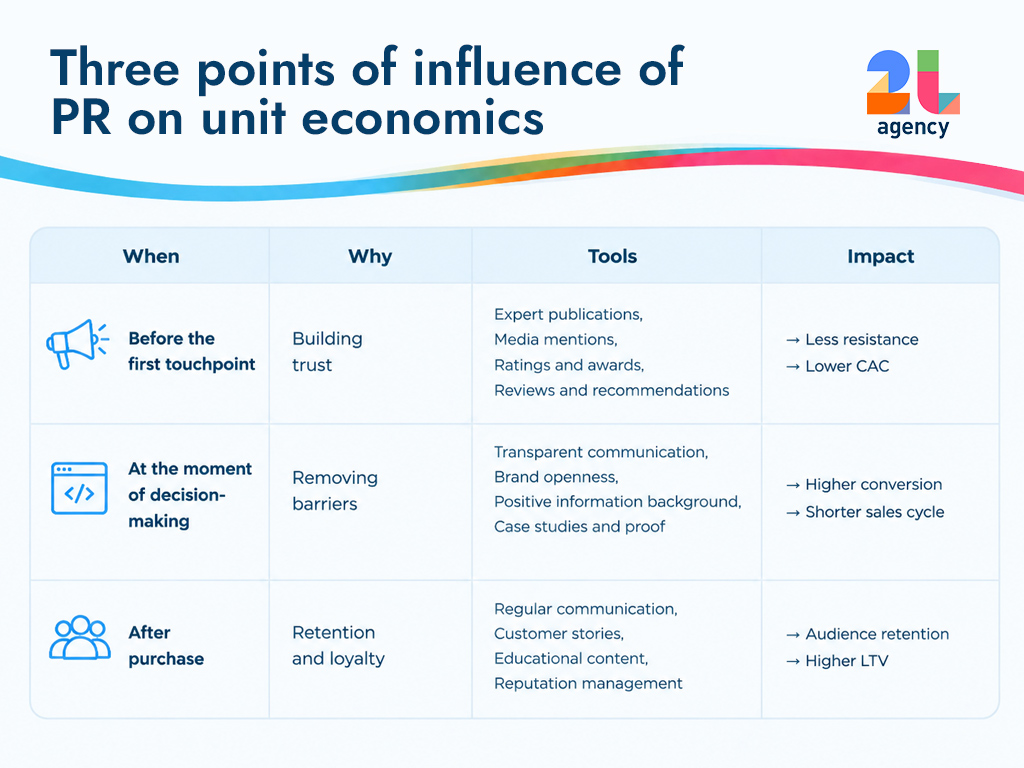
PR works to reduce CAC by creating a trustworthy context before the first contact with the brand. When a company regularly appears in expert materials, media, industry rankings, and recommendations, a potential customer arrives already “warmed up.” They know about the team’s competencies, trust the expertise, and make a purchase decision faster.
This manifests itself in several effects:
- Growth in brand traffic. If a company is mentioned in industry media, referenced by experts, and referred to in reviews, people start searching for it by name. A branded query is always cheaper for contextual advertising (low CPC) and has a higher conversion rate because the user is already familiar with the brand. As a result, the overall CAC decreases, and you pay less for each conversion.
- Conversion growth at each stage of the funnel. A prepared audience is less likely to abandon a deal, has fewer doubts, and requires less effort from the sales team.
- Reducing dependence on paid advertising. A high‑quality publication or speaker’s presentation generates mentions on social media, reposts, and discussions in chats, which creates organic reach that you don’t pay for.
- Shortening the sales cycle. The client has already seen the brand in authoritative sources and is ready for a dialogue.
In practice, this means that with the same marketing budget, the company attracts more customers, and the cost of each lead gradually decreases.
How PR increases LTV
Working with LTV is about retention, loyalty, and the depth of the relationship with the customer. PR here acts as a tool for building long‑term trust and an emotional connection with the brand.
Key mechanisms of influence:
- Strengthening reputation. Consistent presence in a positive information space — publishing case studies, receiving awards, participating in professional ratings — creates a sense of stability: the customer sees that they have chosen the “right” company. This reduces their desire to look for alternatives, and therefore extends the customer’s lifespan (retention).
- Increasing loyalty. Expert content, success stories, case studies, and transparent communication make the brand feel “like one of us.” Loyal customers buy more often, try new products, and are less likely to switch to competitors.
- Growth in average order value and purchase frequency. When we prepare material about a new service, an expansion of functionality, or how one customer successfully uses several of the company’s products, we help the sales department leverage the existing customer base. Current customers see the expertise and start buying more. Trust reduces the barrier to cross‑selling and upselling.
- Reducing churn. When a brand is perceived as a reliable partner, even temporary problems do not lead to customers leaving quickly.
- Managing reviews and crises. Customers appreciate it when a company honestly admits a mistake and corrects it in front of the public. This creates an emotional connection and often strengthens loyalty more than a consistently positive attitude. A loyal customer stays longer and forgives minor shortcomings.
It’s important that PR support doesn’t work in a vacuum: the maximum effect is achieved when it’s synchronized with the product, service, and CRM. But it’s communications that create the foundation of trust on which all other retention tools are built.
Nuances in practice
- The effect is cumulative. PR doesn’t deliver instant results — reputation and trust are built over months of systematic work. But once the trust reserve is created, it lasts a long time and reduces the costs of attracting customers in the long run.
- Synchronization with the product is required. If the product doesn’t live up to its promises, even the best PR won’t save the LTV — customers will leave after their first experience. Communications should reflect reality, not create illusions.
- Measurability through indirect metrics. It’s difficult to track the direct link between PR and unit economics, but you can observe changes in website conversion, deal cycle length, share of organic traffic, and retention rates.
Resume
PR does not replace marketing and does not take on the calculation of unit economics. But it creates conditions in which marketing works more effectively, and customers stay longer.
Trust, reputation, and loyalty are intangible assets, but they directly translate into lower CAC and higher LTV.
In the long term, it is communications that become the lever that allows a business to grow without constantly increasing the advertising budget.
