New product promotion strategy and methodology
We share our expertise based on the knowledge and long-term experience of special projects combining PR and marketing tools.

The goal and communication
Of course, the global goal of any marketing and PR activities, business as a whole, is profit, that is, sales. But when it comes to a specific project, in particular, the launch of a new product or model, you need to understand the introductory and not forget about the stages of the user path. In any case, focusing on sales right away is a direct route to draining budgets. The logic of the events should be directed like this:
- Ensure brand/product awareness.
- Gain trust.
- To push for a purchase.
- To retain a customer and turn them into a loyal brand advocate.
In order for a new product to sell, you first need to tell potential customers about it, then convince them of its value, brand reliability, and ideally establish an emotional connection with the audience. Only in this case we can expect a decision to be made regarding the purchase and a repeat choice in the future.
Make friends with PR and marketing
When building a strategy for any project, we at 2L rely on the PESO communication model. In short, it’s about the synergy of different communication channels, including both PR and marketing tools. But to build a working system, you need to understand the difference.
The objectives of PR are to create a positive image of the company, increase brand awareness, create an emotional connection with the consumer, strengthening reputation and brand loyalty. Marketing is more straightforward – it is aimed at attracting potential buyers, stimulating them to make purchases and, as a result, increasing sales.
To achieve maximum effect, it is necessary to use both approaches: PR creates a positive perception of the brand by a wide audience, and marketing directs to specific products or services, encouraging them to buy.
The structure of new product promotion campaign
Step 0. Preparing for launch
The task is to understand who needs the product and why, what problem it solves, how it differs from competitors, and how the campaign result will be measured.
At this stage, it is important to study the target audience, demand, and competitive field, formulate a USP (unique selling proposition), prepare key messages, and select communication channels. You also need to set up analytics in advance: determine where the data on coverage, traffic, applications, and sales will come from.
It is not necessary to wait for the official start of sales. Even at the preparation stage, you can work with a waiting list, test messages and creatives, collect the audience’s first reactions, and adjust the communication.
Step 1. Work on recognition
The task: To create/raise awareness of the brand and product, to convey to a wide (within the target) audience information about the appearance of the product on the market.
Tools and formats of work:
- Distribution of press releases;
- Reviews in industry media;
- Digests with selections of products in mass media;
- Presentations at exhibitions;
- Sponsored promotion;
- Organization of press tours;
- Content with social media promotion;
- Unpackings and integrations in bloggers’ videos;
- Interviews with top managers of the brand.
Key indicators: Coverage, the number of publications, including news based on the results of the press release distribution, their readability, the number of brand mentions, the dynamics of the number of subscribers in the company’s social media accounts, the dynamics of product/brand queries in search engines.
Step 2. Building Trust
The task: To create a sense of trust in the brand, to justify the reliability of the product, its usefulness to the consumer. Establish a positive emotional connection.
Tools and formats of work:
- Collecting and posting reviews from satisfied customers;
- The company’s responses to reviews, including working out the negative;
- Development of loyalty programs;
- Participation in conferences with industry experts;
- Product analysis by opinion leaders – video reviews, testing by bloggers;
- Collaborations with other reputable brands (for example, when the developer of a popular game recommends certain PC components);
- Text reviews in industry media or popular blogs;
- Online meetings with company representatives;
- Challenges and contests that stimulate UGC content.
Key indicators: The number and quality of reviews, the number of reactions to videos / posts / articles and sharing (for publications on social networks), the tone of comments under the materials. Plus all the indicators that we looked at in the first step: coverage, mentions, full reads, search query dynamics.
Step 3. Marketing activities to stimulate sales
The task: Get traffic to your website or stores and convert it into sales.
Tools and formats of work:
- Incentive promotions and discounts;
- Contextual and targeted advertising, retargeting;
- Special offers/promotions in partnership with other brands;
- Promo codes from bloggers (for videos with integration or review);
- Mailing lists/messengers with individual offers;
- Contests and challenges for prizes and discounts.
Key indicators: CTR and other indicators from advertising cabinets, transitions to stores from links to bloggers’ videos, the use of promo codes, the number of participants in contests, and actual sales.
Step 4. Retention and advocacy
The task: Retain the audience after the first purchase, encourage repeat purchases, and turn satisfied customers into brand advocates.
Tools and formats:
- Personalized offers
- Email and messenger communications after the purchase
- Loyalty programs and referral mechanisms
- Working with user‑generated content
- Surveys, feedback collection, and product refinement
- Community building around the brand or product category
- Repeated integrations with bloggers and expert materials on product usage scenarios.
Key metrics: repeat purchases, LTV, number of user posts, number of recommendations, share of regular customers, NPS, review dynamics.

Olga Kharitonova, CEO and co-owner of 2L:
«Dividing into stages does not mean that you need to work out each one separately. But it is necessary to pay attention to everyone. In practice, we can guide the user through 2-3 stages, even within the same tool».
For example, when a blogger reviews a product, they first introduce the viewer to the brand and the product, then go through the features, and share their opinion on the quality — helping to build the user’s trust. And in the description under the video, they leave a promo code “from me personally” and a link to the online store, encouraging a purchase.
This approach usually works well with small‑ and medium‑sized bloggers if their audience matches your target audience, and the integration format allows the author to really understand the product. However, the choice of a specific influencer always depends on the task, the niche, the cost per contact, and the quality of their audience.
If we talk about a sequential, step‑by‑step approach, it might look like this: first, we study the audience and prepare the positioning, then we publish articles and send out press releases, obtaining news publications. After that, we involve opinion leaders with detailed reviews, launch contextual and targeted advertising with promotions, and then work on repeat purchases and reviews.
Advantages of integrated communications
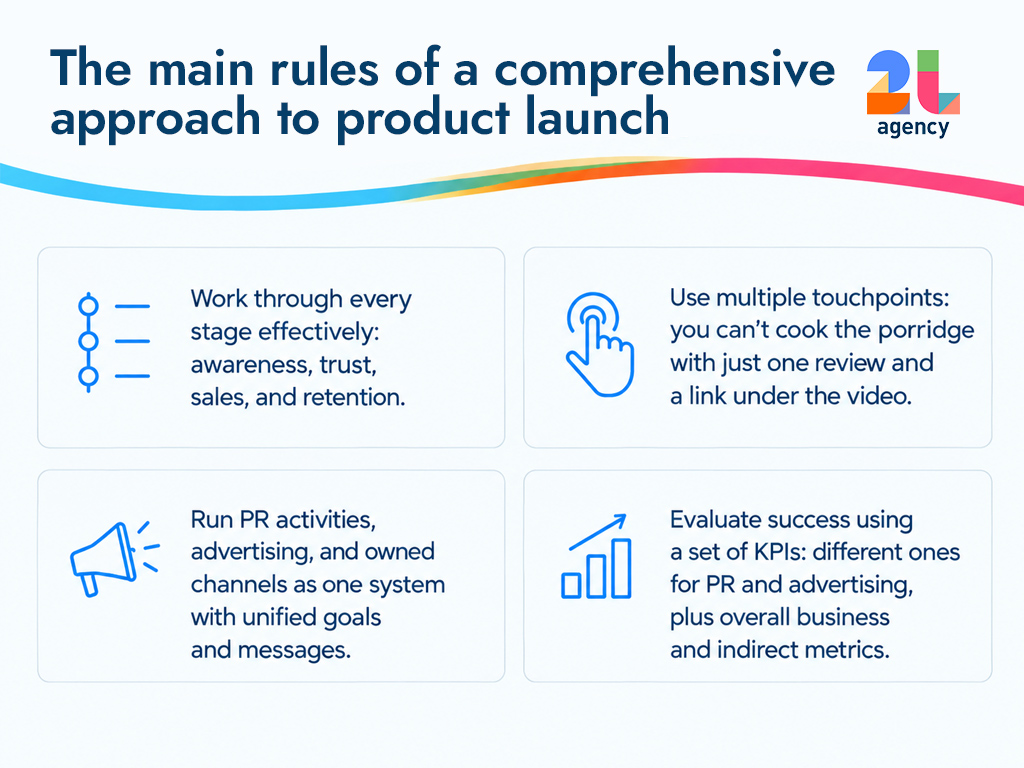
It is important to remember the main principles of an integrated approach: a) To work out each stage with high quality (acquaintance, trust, sale); b) For a reliable result, you need several touches (one review with a link under the video is not a good idea). By combining different channels and building a comprehensive strategy, we get:
- Holistic perception of the brand/product by users.
- Contact with the target audience at each stage of the user’s journey.
- Strengthen communication with the user step by step.
- High KPIs of marketing tools (because they work for an audience already familiar with the product through PR).
- Prolonged effect (the part of the audience that got acquainted with the product, but did not buy it immediately, will return to consideration of the brand when the appropriate need arises).
What is important before developing a launch strategy?
- Target audience: To whom is the product addressed? What kind of people are they: socio-demographic characteristics, hobbies, interests?
- The market and competitors: Is it necessary to generate demand, or is there demand, but it is important to break away from competitors?
- The brand’s position in the market: How long has the brand been around, what does the audience know about it, and what is its reputation?
- Strengths and weaknesses: What are the key advantages of the product, and what are the weaknesses?
- Communication channels: Where can I find your target audience? Where do most of the audience get into your target audience?
- Geography: Is this a local project, or is it necessary to promote the entire Russian Federation, or several countries?
- Time frame: When do you need a result?
It is important to register these points at the start, since the strategy of the campaign, its scale, and, consequently, the budget will directly depend on them.
In conclusion, we would like to emphasize once again the main principle that we adhere to when planning such campaigns:
In order for a new product to launch successfully and make a profit, you must first introduce your brand to the consumer, clearly explain the value of the product, earn trust, and only then encourage them to make a purchase.
We have repeatedly proved the effectiveness of this approach with the agency’s cases.
If your team is tasked with strategically promoting a new product in the Russian market – focusing on building awareness, trust, and demand, rather than just launching an advertising campaign – the 2L team is ready to join the project. Submit a request using the button below or via email at sales@2l-pr.ru
16.07.2026