What is media monitoring?
Quick answer:
Detailed answer:
Media monitoring is the systematic tracking of publications and mentions of a company, brand, product, executives, or experts in the information space. It includes not only traditional news outlets but also industry‑specific media, regional websites, blogs, and other platforms where audience opinion is formed.
However, good monitoring is not a folder with links or a spreadsheet for the sake of reporting. Its task is to show what is happening around the brand, explain the significance of what is happening for the business, and help choose further actions. Therefore, it is important to distinguish between three levels: which publications have been released, what they mean, and how to respond to them.
What is being tracked
First and foremost, the number of mentions is analyzed. This is an indicator of the brand’s presence in the media space, but on its own it does not indicate the quality of communication. For example, a large number of publications may be the result of short mentions in which the company is only mentioned in passing. Therefore, the data is considered in combination:
- tone – the emotional tone of the publications: positive, neutral, or negative;
- reach – the approximate number of people who could have seen the materials;
- MediaIndex – a comprehensive assessment of the visibility and quality of a brand’s presence in the media;
- share of voice (SOV) – the proportion of mentions of the company compared to its competitors;
- brand role – whether the company is the main subject of the publication or is mentioned only peripherally;
- key messages – whether the materials contain the necessary key points and meanings.
- quotes and references – whether there are comments from company representatives and links to its resources;
- industry representation – in which segments the media brand is noticeable, and where it is almost absent;
- recurring themes – whether different platforms pick up the same story or whether the publication remains isolated.
The quality of the source also matters. Mentions in federal media, a specialized publication, an expert’s Telegram channel, and a small niche resource have different effects, even if the formal reach of the platforms appears comparable.
How monitoring is carried out
For this purpose, there are special media analytics services available today. The 2L communications agency works with Medialogy. Other well‑known platforms include SCAN‑Interfax, PressIndex, and Babkee. For social media and online discussions, there are their own monitoring systems — for example, the aforementioned Medialogy has a separate product called Medialogy SM.
First, a list of key objects for monitoring is compiled: brand, product line name, specific product, speaker. Then, an analysis period is set, the found publications are checked, and mentions, as well as qualitative and contextual indicators, are assessed.
It is important to define the goal in advance. If a company wants to increase brand awareness, the main indicators will be reach, the dynamics of mentions, and share of voice. In a crisis situation, the tone, the speed at which a negative topic spreads, and the quality of the response come to the fore.
What conclusions can be drawn from the monitoring?
Analysis helps to understand which topics resonate with the audience, which speakers are more trusted, which platforms are more effective, and how the brand’s presence in the media changes over time. It also reveals recurring questions and complaints, weaknesses in communication, and areas where the company can strengthen its expert position.
For example, a sharp increase in publications after an expert’s comment may mean that the topic has hit a sensitive nerve. And a large number of neutral and negative mentions is a reason to find out what exactly is bothering the audience: the price, the quality, the service, or the poor wording of the message.
Based on the monitoring results, you can update the content plan, select priority media outlets, prepare a series of comments or original materials, and, if necessary, launch anti‑crisis measures.
What to pay attention to
You shouldn’t draw conclusions based on a single monthly report or a single publication. It’s better to look at the dynamics over six months or a year, compare comparable periods, and take seasonality into account. It’s also useful to compare the results with those of competitors: high reach in itself doesn’t mean a strong position if other brands are more prominent and more often become the main characters of the materials.
If a contractor provides you with a media monitoring report, it is important to pay attention to the calculation methodology: which sources were taken into account, how coverage was determined, what rules were used to assess the tone, and what is considered a mention. Without these explanations, the figures may create a false sense of effectiveness.
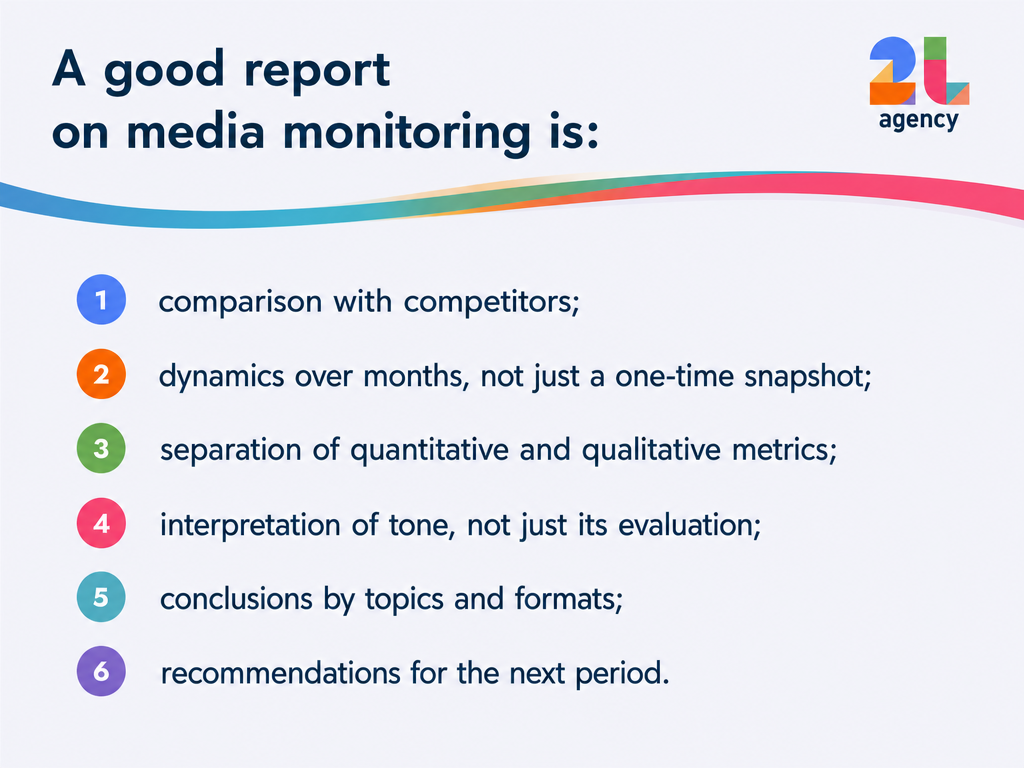
Thus, media monitoring is not a report on the fact of publications, but a tool for managing reputation and communications. It should answer three practical questions: what is happening in the information space, why this is important for the business, and what actions will help improve the situation.